Point-of-Sale Firmware Revisions and Batch Timing Adjustments for Independent Retailers Handling Variable Daily Volumes
Ellis Koch · Jul 21, 2026

Point-of-Sale Firmware Revisions and Batch Timing Adjustments for Independent Retailers Handling Variable Daily Volumes
Independent retailers managing daily sales that swing from quiet mornings to sudden rushes have turned their attention to point-of-sale firmware revisions and the precise timing of batch settlements. These technical elements directly influence transaction reliability, reconciliation speed, and operational costs when volumes refuse to follow predictable patterns. Firmware updates often arrive with patches that strengthen encryption protocols, refine communication with payment networks, and introduce scheduling tools for batch processes.
Retailers note that older firmware versions sometimes create delays during peak periods because they lack optimized handling for mixed transaction types. Revisions released in the first half of 2026 addressed several of those bottlenecks by improving how terminals queue authorizations when card-present and card-not-present sales arrive simultaneously. Data from Payments Canada shows that merchants who installed the March 2026 patch set reduced average settlement failures by 18 percent during high-variance days.
How Firmware Revisions Alter Daily Operations
Each firmware cycle typically bundles security enhancements with functional changes that affect batch behavior. The July 2026 release cycle, for instance, introduced configurable batch windows that let terminals automatically shift settlement times based on real-time volume thresholds. Retailers who activated this feature reported smoother cash-flow alignment because the system could hold batches until cumulative sales reached a preset dollar amount or until a chosen hour arrived, whichever came first.
Technicians at service providers emphasize that these revisions require coordinated testing across hardware models. Terminals running legacy chipsets sometimes need additional memory allocation before the new code installs cleanly. One study conducted by researchers at the University of Melbourne found that stores completing staged rollouts over two weeks experienced 12 percent fewer downtime incidents than those attempting immediate full deployment.
Batch Timing Adjustments for Fluctuating Sales
Batch timing determines when authorized transactions move from pending status to settled funds in the merchant account. Fixed schedules work adequately for steady-volume businesses, yet they create friction for retailers whose daily totals vary by 40 percent or more. Adjusting the window allows a terminal to batch early on high-volume days and later on slower ones, which reduces interchange exposure and accelerates deposit availability.
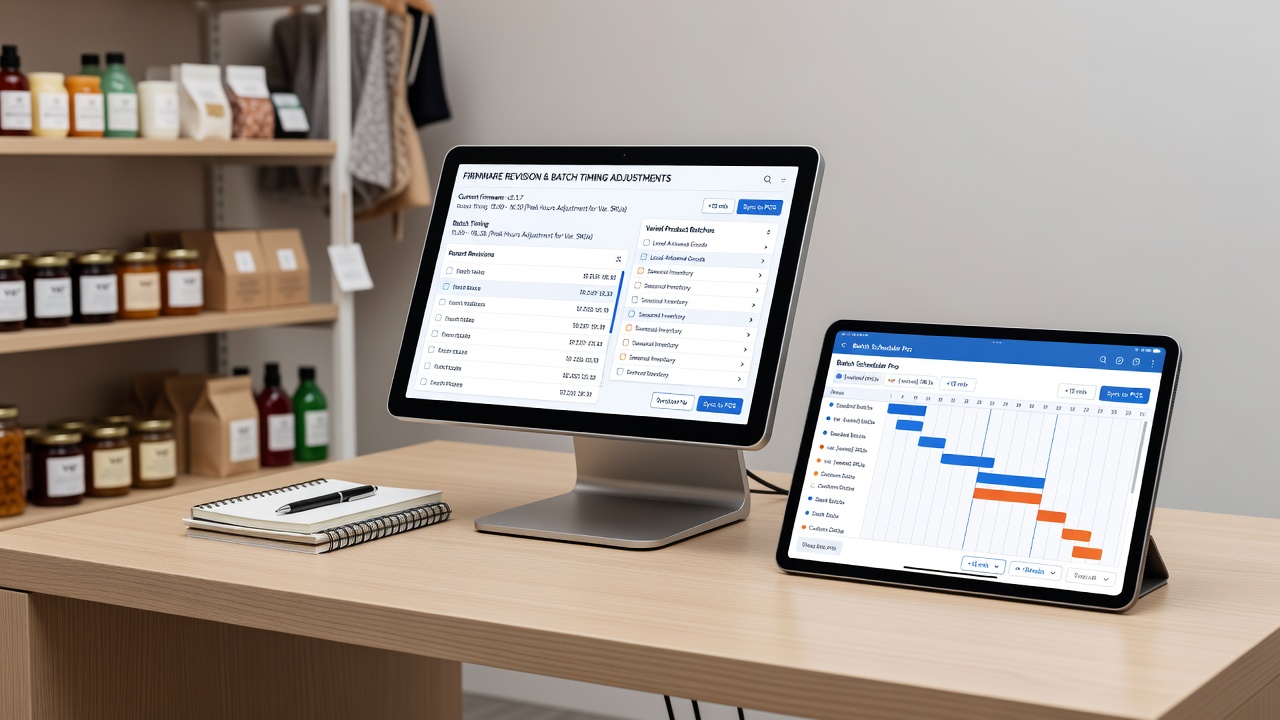
Many terminals now expose these controls through the same dashboard used for inventory and reporting. Store operators can set rules that trigger a batch once sales exceed a certain figure or when the clock reaches a defined cutoff, and the firmware enforces the rule without manual intervention. European Central Bank figures indicate that merchants using adaptive batch logic cut their average funds-in-transit period by nearly one day during seasonal spikes.
Implementation Steps and Compatibility Checks
Retailers begin the process by confirming that current hardware meets the minimum specifications listed in the release notes. Technicians then download the firmware package through the acquirer portal and stage it on a test device before pushing it to active terminals. Once installed, staff verify that batch schedules appear correctly in the configuration menu and that test transactions settle according to the new parameters.
Compatibility concerns surface most often with integrated systems that connect the terminal to accounting software or loyalty platforms. In those environments, a firmware revision may require a matching update on the backend server so that reconciliation files continue to parse without errors. Observers at the National Retail Federation note that stores completing joint testing with their software vendors avoided the majority of post-update reconciliation mismatches.
Monitoring Performance After Updates
Following deployment, retailers track settlement success rates, authorization response times, and any error logs generated by the terminal. Most acquirers supply automated reports that flag deviations from expected batch behavior within the first 48 hours. When anomalies appear, support teams can roll back to the previous firmware version while the root cause receives investigation.
Those who studied adoption patterns across independent stores found that weekly review meetings during the first month after an update helped surface minor configuration tweaks that improved overall reliability. The same data sets also revealed that retailers who left batch windows at default settings saw less benefit than those who calibrated the timing to match their specific sales curves.
Conclusion
Firmware revisions and batch timing adjustments continue to give independent retailers practical levers for managing the realities of variable daily volumes. By aligning system capabilities with actual sales patterns, stores reduce friction in the settlement process and maintain clearer visibility into available funds. Ongoing releases scheduled through the remainder of 2026 will likely refine these tools further as payment networks standardize new data fields and security requirements.