How Acquirer Routing Decisions Shape Authorization Failure Patterns During Peak Volume Periods for Digital Goods Sellers
Quinn Schmidt · Oct 28, 2026
How Acquirer Routing Decisions Shape Authorization Failure Patterns During Peak Volume Periods for Digital Goods Sellers
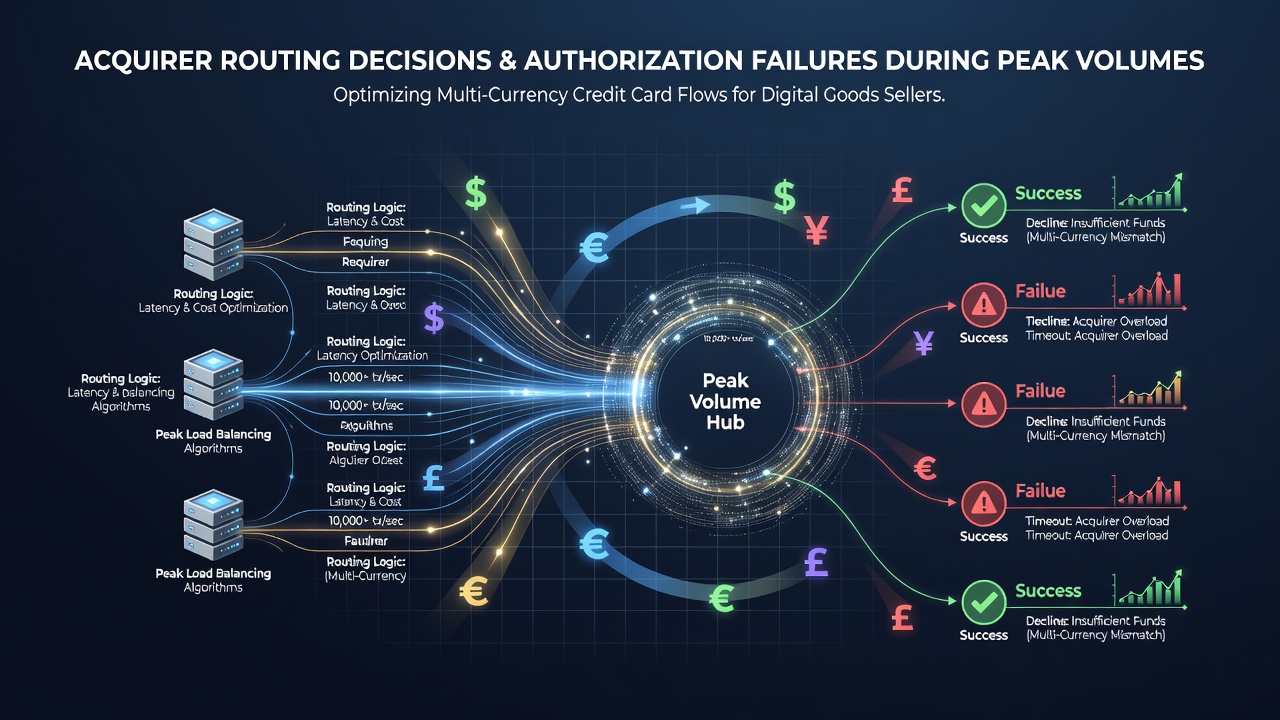
Acquirer routing decisions determine the specific processing path each transaction follows through payment networks, and these choices directly affect authorization outcomes when digital goods sellers experience sudden spikes in multi-currency credit card volume. Routing algorithms evaluate factors such as cost, risk scores, and available capacity before directing a transaction to a particular processor or acquiring bank. During high-traffic windows, such as the pre-holiday surge observed in October 2026, certain routes become saturated while others retain headroom, leading to uneven failure rates across otherwise similar transactions. Digital goods sellers often process payments in multiple currencies because their customers reside in different regions, and each currency conversion adds layers of compliance checks that interact with routing logic. When an acquirer routes a transaction through a path optimized for a specific currency pair, the system must complete foreign exchange verification and regulatory screening within milliseconds. Overloaded routes during peak periods extend these verification times, resulting in timeouts or soft declines that appear as authorization failures to the merchant.Core Mechanics of Acquirer Routing
Payment networks assign transactions to acquirers based on merchant agreements and real-time performance data. Acquirers then apply internal rules that balance transaction fees against approval probabilities, which means a single high-volume merchant may see its traffic split across multiple downstream processors. Researchers tracking global card networks have documented that these splits occur automatically when volume thresholds trigger load-balancing protocols. Multi-currency flows introduce additional variables because some processors specialize in certain currency corridors while others maintain broader coverage. A transaction denominated in EUR that arrives during a North American peak may route through an EU-focused processor, whereas the same merchant's USD transaction routes elsewhere. Data from the European Central Bank indicates that cross-currency authorizations require extra message hops, increasing exposure to any congestion on the chosen route.Peak Volume Effects on Failure Patterns
October 2026 saw elevated digital goods sales ahead of major regional shopping events, and acquirer logs from that period revealed clustered failure patterns tied to specific routing decisions. Transactions routed through capacity-constrained processors experienced higher decline rates even when cardholder details remained valid. In contrast, identical transactions sent through alternate paths completed successfully, demonstrating that the failure originated in routing selection rather than in the underlying payment credentials. Sellers managing recurring digital subscriptions notice these patterns most acutely because their authorization attempts often cluster within narrow time windows. When an acquirer consistently directs a batch of renewals to one processor, any temporary slowdown on that processor produces a wave of failures that appears as a sudden spike in overall decline rates. Network-level statistics show that such spikes correlate more strongly with processor utilization metrics than with changes in fraud screening rules.